Search Words

Wednesday, May 21, 2014

Objectifying Relationships

I was recently having a chat with some friends when a 'relationship' hoved into the conversation.  My friend went from talking about the person to an 'it.'  The it was the relationship.
 
Part of recovery would seem to be able restoring 'relationships.'  The word is very helpful in expressing our connections to others.  But, it is also a problem.
 
When we 'incarnate' a 'relationship' and give it a reality of its own, it becomes a barrier between the two in the 'relationship.'  Often, our relationships are barriers, filled with rules and expectations and demands and anxieties.  We no longer approach the person as he is, but in terms of all the rules that must be met in order to maintain the connection.
 
It becomes a departure from reality.
 
As with all fantasies, having a barrier is very comforting.  It affords us some 'protection' in that we can point to a violation of the rules and say, "Ah, you broke #47, so I don't have to respond (or care)."  The relationship makes interactions predictable and far less personal.  If you are vulnerable, you just make sure all of your relationships have rules that preserve your privacy.
 
Relationships become a way of keeping people away from us.  You can have hundreds of them, like your Facebook pals, that you would never give a kidney to.  Someone is broke and needs $1,000?  "Sorry, we don't have that kind of relationship..."
 
In reality, there is no such thing as a relationship.  It is an adjective and nothing more.
 
There is only you and me.
 
We can't even really have a relationship with God, because there again something comes between us and Him.  The whole point of all those medieval theological debates about whether God's energies are 'created' or 'uncreated' always came back to that point: does having a 'relationship' with God mean that there must be a created barrier?
 
Just in case you are wonder, the Orthodox position is 'no.'  Nothing comes between us, and so the perception of God is a perception of His uncreated energies... something coming from Him that is Him, not a created blocker between us and His essence.
 
So, what about love.  And mercy.  And compassion.  Aren't we asking these things from Him?
 
Again, the answer is in the language: are those proper nouns, or synonyms?
 
We are of God. Whoever knows God listens to us, and he who is not of God does not listen to us. By this we know the spirit of truth and the spirit of error.  Beloved, let us love one another; for love is of God, and he who loves is born of God and knows God.
He who does not love does not know God; for God is love.
In this the love of God was made manifest among us, that God sent his only Son into the world, so that we might live through him. In this is love, not that we loved God but that he loved us and sent his Son to be the expiation for our sins.  Beloved, if God so loved us, we also ought to love one another.
No man has ever seen God; if we love one another, God abides in us and his love is perfected in us.  By this we know that we abide in him and he in us, because he has given us of his own Spirit.  And we have seen and testify that the Father has sent his Son as the Savior of the world.  Whoever confesses that Jesus is the Son of God, God abides in him, and he in God.
So we know and believe the love God has for us. God is love, and he who abides in love abides in God, and God abides in him.  In this is love perfected with us, that we may have confidence for the day of judgment, because as he is so are we in this world. There is no fear in love, but perfect love casts out fear. For fear has to do with punishment, and he who fears is not perfected in love. (1Jo 4:6-18)
 
If there is love, then it is not just a substance but God Himself.  Love is an action, and yet something that permeates us as God in His transcendence imbues all things.  We are constantly awash in His love, but we tend to ignore it.
 
If marriage is an icon of Christ and the Church, then where is the 'relationship' between a husband and a wife?  There is none.  It is two people being united directly to one another, surrounded and permeated with the Love that is God.
 
If another person is made in the Image and Likeness of God stands before us, why should we put up a barrier?  It is because we are weak: we cannot bear to look upon this Image in others because it pains us.  We are reminded of our own sins and selfishness and fears.  So, we build walls called 'relationships' and invent etiquette to make sure we can cut off the contact when it becomes uncomfortable.
 
"No shoes, no shirt, no service" reads the sign on the door of the relationship.
 
But, God's love is about taking down the barriers and loving others as they are, with nothing in between.
 
Horrifying prospect, isn't it?  Now you know why saints do what they do to repent and be humbled, because you can get there while maintaining your 'comfort zone' which is also an exclusion zone.
 
For most of us, we try to make the walls a little thinner and a little lower.  We start tossing some of the rules, and stop freaking out when the rules get broken.
 
Believing in God calls us to courage, which we receive in return for our trust in Him.
 

Monday, May 19, 2014

Gluten 'Intolerance,' Addiction, and the Power of Suggestion

I have not seen this discussed anywhere, so I am straying into uncharted territory.  Of course, this is not the first time for me, as the scratches in my 'hull' show ample proof of my ability to stray off the charts and find where the unknown reefs are.  So, let's begin!
 
 
So, this article seems to indicate that many people with 'gluten intolerance' are having a reaction based on psychology rather than physiology: the mere suggestion of gluten is enough to send them into a symptomatic downward spiral.  Sure, they are experiencing real pain and suffering, but the question is what is the cause?
 
Now, I've gotten all the usual name-calling and breathless diatribes about how horrible I am for suggesting that people are 'making it up.'  You can try that and waste your energy.  In fact, part of why I am so convinced that many of these cases are psychological is the over-the-top and harried defense of the legitimacy of such disorders, even when I am not questioning actual cases of Celiac or medically-diagnosed problems.
 
What I am questioning are the countless thousands that have self-diagnosed themselves and take up the mantle of those who really are suffering.
 
But, then it got me thinking: how much of the problem of addiction and the magnificent attraction of our obsessions is less about the power these things really have but how much power we attribute to them?
 
We often speak of alcoholism as being part psychological and part 'allergy,' and that is how I began to make something of a connection: is there a genuine 'allergy,' or is this 'allergy' something like a psychosomatic reaction that we think our way into?

With all the glamorization of alcohol, are people really experiencing a super-powerful effect because that is really what is going on within them biochemically, or are they creating this effect strictly in their own minds?  Who remembers choking on their first cigarette, and then immediately trying to hold another one down in order to participate in the glories of smoking?

Drinking and drug use have no doubt been glamorized by media: how many songs have been devoted to the benefits of these?
 
Warning: Graphic Language (i.e. bad words)


I'm posting this version because it is a mockery of the original.  But, in this one song is the abuse of alcohol, drugs, subjugation of women, criminal activity... all rolled up into a catchy beat.  Fantastic, isn't it?  It makes all these things seem far more exciting than perhaps what one would experience in a ghetto apartment or desert trailer park, but if you have convinced yourself that these things really are that great... could this be the 'allergy' that so many people seem to 'contract'?
 
This is the gray area of the allergy factor, where people experience real symptoms (which is why many people are so very hurt when you question their allergies, because regardless of the source, they are really suffering) but because of thinking.
 
Don't forget that addiction is a problem of perception, first and foremost.  This is why the 12 Steps are mostly about changing one's perceptions rather than one's experience of alcohol.  Anabuse and other tools that work with classical conditioning have limited effect on a direct confrontation with alcohol and other drugs because they are simply too narrow in scope: addiction runs deep into the fabric of the human person, to the core of our worst fears and the passions we suffer with.
 
We have all seen the addict who comes to hate the experience of his addiction, and yet cannot stop.  The same is often true of other allergic syndromes and the people who suffer from them.  I am not saying that people with psychosomatic allergies like having them (sure some do, just as some people enjoy their addictions).  The thinking in both cases run far deeper than like or dislike.  They run straight to the murkiest layers of the human will.
 
We have only just begun to understand the interplay between the human brain and the body.  There are plenty of books out there documenting the amazing discoveries of science in this field, which I think are helpful in putting right our own expectations of what we are up against in addiction and recovery.
 
The area of psychosomatic allergies is one that will help us better understand the power of addiction and how our own minds often make trouble for us in the journey of this life.


Friday, May 16, 2014

A Life Without Meaning

A rather sad story from the UK, that is really common in the modern world-
 
 
Of course, the connection here is with unemployment.  In the Western world, with its particular emphasis on materialism (call it 'capitalism,' 'corporatism,' 'fascism,' 'socialism,' 'distributionism,' 'mercantilism,' 'communism,'... you get the point), then what passes for identity is how one partakes of the material world.
 
We do that by 'making' money.  Our career is, therefore, the pinnacle of identity.
 
No longer is man defined by religion and spirituality, or family, or regional origin, or even citizenship. 
 
"What do you do?" is the most common question after asking one's name.  So, when you lose your job, or your career is taken away, then who you are comes into question.
 
You may get away with prepending 'retired' to one's old profession, but for many people, that just seems rather silly when you are 24 years old and have not held the same job for more than two years.  When you are young and have few accomplishments, identity is unstable when it is defined by a career.
 
So, we wrestle with why we exist, particularly when we do not have a fixed identity.  We wonder what we are and why we are at the same time.  So, why do we exist?
 
The sillier answers sound something like this:
 
"God created us to worship Him."
 
Wrong, wrong, wrong.
 
If you want to know why the Church says God created us, then just read this snippet from the introduction to the Philokalia written by St. Nikedemos the Hagiorite-
 
God, the Blessed Nature, the Transcendent Perfection, the Creative Principle of all good and beautiful things, Transcendently Good and Beautiful, having from eternity destined according to His Divine Idea to deify man, and having from the beginning within Himself set this purpose, created man at a time when He was well pleased.
Making the body out of matter and placing inside it a soul which He created, He set man as a sort of a cosmos, great by virtue of the soul's many and superior powers, in a small cosmos. He placed man as a contemplator of Visible Creation and as an initiate of Intelligible Creation, according to the Gregory (bishop of Nazianzus [c. 329-390]) who is great in Theology.  And what else but as really a statue and a divinely made image full of all the graces. And having given him the Law of the Commandments as a kind of test of his power of free choice and self-control. And as Sirach says, He left man in the power of his own deliberation (Wisdom of Sirach 15:14), to choose according to his own opinion in each situation. And as a prize, to receive the hypostatic gift of theosis, becoming God (ed.- In the sense of participating in God's "energies.") and shining eternally with the purest Light.  (St. Nikodemos of the Holy Mountain, Introduction to the Philokalia, trans. C. Cavarnos, The Philokalia, vol. 1 [Belmont, 2008], p. 27.)

God made man because He wanted to.  Nothing more.
 
He places within us what it is that we sense: an interior cosmos that is greater than the world into which we are born.  The very Image of the Divine is, in fact, after which we are fashioned.  Then, we are thrust into a small world that is dirty and sticky, and somehow feels both inviting and inappropriate at the same time.  We love the world and despise it at the same time.

When we are not shown the way through this world, then it becomes a depressing journey of futility.  We are called to be 'initiated' into the deeper mysteries of the world, and ourselves.  It is not a secret path to initiation, but one of hardship and suffering that is both public and private.  The books are open, and the secrets are known.  The 'secret' is getting the secret rather than just knowing about it.  It is the experience of it.

When your life has no vastness, no mystery, but just a day-to-day struggle to put food in your mouth and clothes on your back, then it will always be something of a disappointment once the food is eaten and the clothes put on.  The only challenge is one of quality and quantity, but nothing exists beyond them.

Unless you move through and beyond.  Unless you stretch your thoughts into this vast interior cosmos to find the Eternal God that lies within.  The light is not your own, but a Divine Light that is not you, but has made you our of the purest of love.

That's the mystery.  And, that is the thing we long to live for.  It gives us not 'purpose,' but 'value.'

It makes life worth living.


Wednesday, May 14, 2014

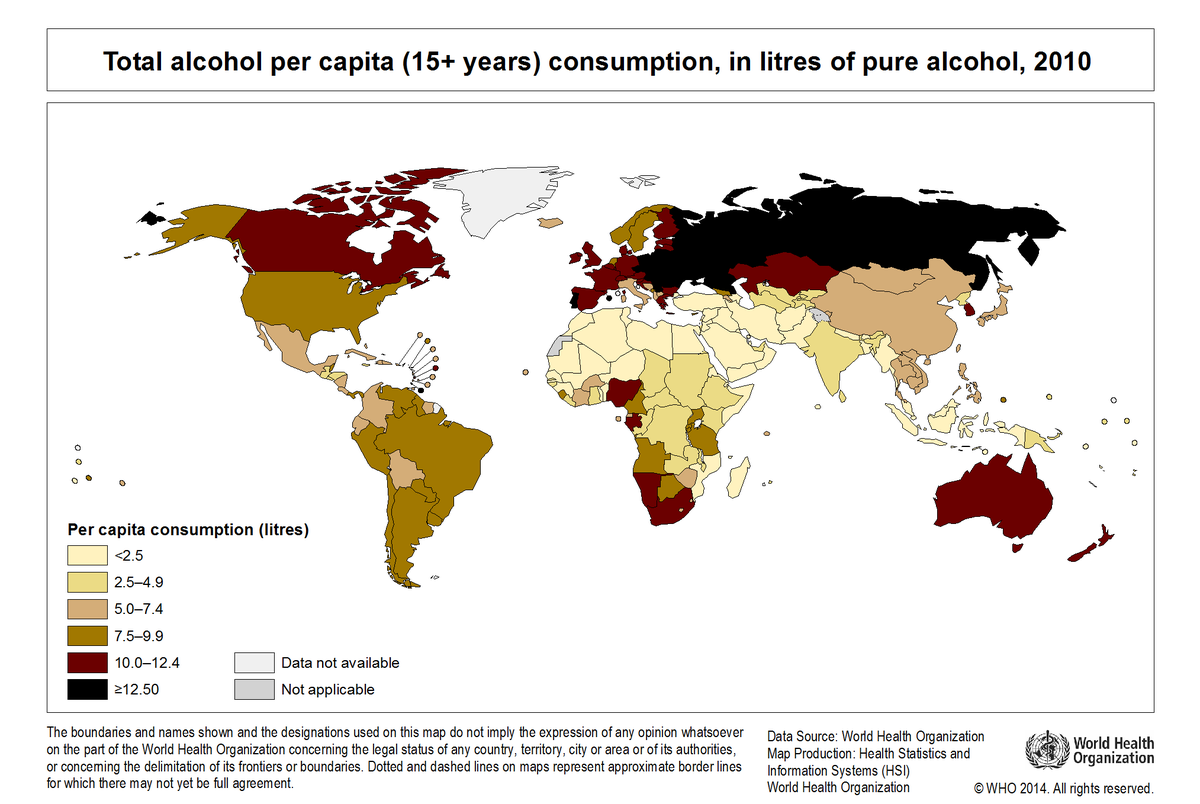
Where is your country?

Consuming alcohol isn't a problem... over-consuming is.  I think this map tells us an awful lot.


Of course, this only tells part of the story of addiction.  This is just alcohol, and other substances, like food and drugs (street and prescription), are not included.  Behavioral addictions, like internet pornography, are also not scored here.  In fact, I doubt many countries with the highest per capita use of porn (like Pakistan) are even tracking the phenomenon of addiction.
 
Having visited 'black' and 'red' territories, I can say that there is a noticeable difference between those regions and the US.  While alcohol is heavily marketed in the US, public consumption and drunkenness are rare (other than outside of clubs or college campuses on weekend nights).  Whereas the Helsinki Metro, in the middle of the day, seemed like a place for drunks to enjoy a little ride between binges.  The Moscow Metro (in a 'black' territory according to the map) was even more so (with most of the culprits dressed in camouflage for whatever reason... Russians seem to have a passion for camouflage).
 
So, what can we learn?  In Finland, for example, the rate was under two liters leading up to the 1960s... now they are at over ten.  Russians have always drunk vodka, but now the rates are unimaginably high.  Why?
 
My theory is simple: as traditional culture and family life are repressed, the human person is left wounded and needy.  Alcohol and drugs are easy alternatives to fighting the social message of dialectical materialism and the overstimulation of modern life, not to forget how alcohol takes away the pain of an oppressive society.
 
We are seeing the gradual wearing down of billions of lives.  Our unnatural existence is catching up with us.

Tuesday, May 13, 2014

4 in 10 Children...

Of course, this is just a guess-
 
 
But, underneath it all is a question: how is this effecting their brains and mental development?
 
I have three children of my own, and I worry even though I do allow them access to the internet, part for school and, in small doses, games & entertainment.  There is a time limit set with a timer, because they will play for hours if permitted.
 
The internet is powerful, so much so that it can drown out the real world.  Like all addictions, there is a 'man takes a drink, then a drink takes a drink, then the drink takes the man' effect.  The neurochemical rewards computer games offer a young mind seeking stimulation are undeniable.
 
It is a constant battle to keep my children focused on the material of the internet rather than the experience of it as an end game.  I am hoping they learn to use it to accomplish tasks away from it, rather than seeing their self-worth and sense of accomplishment as tied up with the internet.
 
So far, this seems to be happening.  Crafting projects, books, and conversations with live people still seem to be pretty important around here, but it is because of self-discipline above all else.
 
Still I worry that perhaps I am laying the groundwork for later problems.  I wrestle with the possibility that the one-hour allotment is still too much.  What I have come to accept at some level is that the internet will be with them long after they are emancipated by age, and so I must show them the way of moderation... and then pray.
 
The internet is a dangerous companion.  In some ways, it is like being a lion-tamer: while it may serve your purposes and be 'obedient,' there is still a wild animal in front of you that can revert to a very dangerous beast at the drop of a hat.
 
Susceptibility is the key: am I, or my children, healthy enough to use it?  If not, then we are susceptible to abuse not only the internet, but any other manner of substance or behavior that releases similar biochemical.
 
In the end, the 'net is neutral: we are the problem.

Friday, May 9, 2014

The Sound of Silence: Influence in the Visual Age

My latest reading has been Aldous Huxley’s Brave New World and the follow-up written in the1950s. I took an interest after a reader mentioned ‘soma’ in a comment, which led me to read the book (I recall back in high school that this novel was on our reading list, but I somehow managed to avoid it along with most other classics).
Huxley’s second book has raised many issues (as did BNW), most especially the matter of influence on perception and decision-making. Huxley’s analysis of influence, which is surprisingly prescient considering it is almost 60 years old, is not entirely without anachronisms, and by that I am not focusing on his technological and social references, which it is to be expected that they would be out-moded. Rather, it is about how these technological matters have come to change how we are influenced.
Huxley assumes that man is influenced largely by audio messaging. He consistently returns to the idea that modern man in influenced by what he hears, and how audio recordings can be used to retrain or condition people to accept certain messages.
My sense is, after spending some time studying the effects of internet pornography and computer-based addictions, that technological advances have altered our senses to the point where we are now largely visual creatures. We use our sense of vision far more than any of our other senses, perhaps combined.
Vision is by far the most complex of the physical senses (perhaps in a later post I will get into the topic of ‘complex’ versus ‘physical’ senses). It embraces numerous layers of sensory analysis and regions in the brain. So, it is already ‘dominant’ in the respect: vision occupies a lot of territory in the brain.
Yet, our technology has tilted the brain even more in the direction of favoring vision over the other senses. Computing is, above all else, a visual activity. While we use cue sounds and have a wide array of audio headsets, we largely rely on the computer monitor to complete our computing tasks. Man’s natural favoritism for vision has found its perfect companion.
Reading, typing, looking at pictures, watching videos, playing games... these are all visually-dominant activities. Even the massive explosion of the MP3 and exceedingly small audio devices of escalating quality hold no match for the ‘Arms Race’ in consumer electronics to provide better and better screens. TVs and personal computers boast more about their video quality over and against their audio capabilities. Speakers are more of a luxury item, whereas the video card of the PC reigns as the supreme necessity.
And so it is that our ‘plastic’ brains are constantly being encouraged to ever-increase the areas of the brain devoted to vision. What this also means is that other senses, like hearing and smell, become less important and even distractions. After all, man has a ‘limited bandwidth’ in regard to how much sensory input he can consciously handle. Once the limit is reached, everything over the limit is stuffed or missed.
While some may make the argument that subliminal influences can be achieved through this ‘unattended baggage’ of the sensory variety, what is absolutely certain is that the things we actually pay attention to are far more influential. What we concentrate on naturally influences us in a stronger way because these messages, whatever they may be and however we feel about them, are taking up more space in our limited minds.
This brings me to the matter of addictions involving vision, primarily pornography and video games. In both cases, the addict enters into a behavior that involves a very dominant part of his brain. Modern media has expanded and enhanced his visual powers, leaving him far more prepared for the onslaught of images that the internet has made possible.
Part of this ‘conditioning’ of modern media is how we use visual images to shut down our higher reasoning and critical thought. We ‘veg out’ in front of the TV, or demand that movies be so visually powerful that we forget that they are entirely fiction (especially in the age of CGI). Years of TV watching has helped us reflexively turn off reasoning and even careful observation of the messages behind the sensual tsunami that HD video brings us through our LCD and Plasma screens.
Our politicians must be visually pleasing. Our reactions to them and our opinions of them are less about what they say then how they say it: we judge them by how they look. If we listen, it is hardly attentive, as we often become angry at them for doing things they promised to do, while failing to fire them when they break their promises. After all, we voted for them not necessarily based on their performance records, but how their images make us feel.
Religion in America is no stranger to this phenomenon. The sermon is expected to be more about its musical qualities, like cadence and intonation, rather than whatever heresy or madness is being spewed. We like sound and fury rather than ideas.
The modern Orthodox Church is no exception. People demand semi-transparent iconostasi and Royal Doors wide enough for a truck to pull through... because we want to see, even if that means watch a priest’s vested hind-quarters for hours on end. Canned lights, lots of them, are a prerequisite to any new parish, while oil lamps are hung above the icons because we like the shiny lampadas but hate how they block the view. We don’t need their illumination... Mr. Edison took care of that for us.
Old churches had chairs facing in all directions, usually following the contours of walls and pillars, a majority with no advantageous view. Why? It is because people used to come to church to hear the word rather than watch a show. Now, we have parishes with stadium seating based less on acoustics than on an unobstructed view. In fact, when we aren’t staring at the non-show on the altar, we stick our noses in service books that were once provided when services were in a non-vernacular language. Now, we have simpleton translations being chanted to a whole congregation reading along because, they readily admit, they can’t manage to listen.
All the while, we complain about lonely we feel. Nobody listens to us. We have forgotten what listening is.
Think about someone you know who has lost his hearing. What do the newly-deaf complain about? The loss of companionship: communication is hard when you can’t hear. How much more is it lonely when you can’t hear what others are saying because you’ve lost the ability to listen. Of course, if you can hear someone’s response to what you are saying, what’s the sense of communication to begin with?
Social media is all visual, which is why we flock to it as a replacement for the companionship we once got from talking to one another. We ‘chat’ by typing, and text to have the effect of a conversation. Once you go down the road a little way, and soon an actual verbal interaction with another person becomes a burden.
This loneliness causes us to suffer so greatly that we drink and use, thereby ensuring that we go further down the lonely path of the self. We are cut off by our addictive substances and behaviors. Visual reality is powerful, but it is not nearly as intimate as such sensations as touch, taste, and sound.
For a long time, we have sought to push back these other sensory experiences, or at least control them. We want odorless homes and static temperatures.
Think about music and how we listen to heavily edited, technically perfect music in our MP3s. Our music is flawless, and so we can listen to the same song sung the exact same way a million times, without so much as a single missed note (unless the album producer puts it in). Live albums are definitely second-preference to studio-recordings enhanced by Auto-Tune. So, we can listen to music without the distraction of having to process the mistakes and variances that live performances have. We don’t even complain about lip-synching and end us screaming through a band’s performance rather than being quiet enough to appreciate the talent of our favorite artists. Meanwhile, concert promoters are looking for ways to enhance the visual aspects of the performance.
This brings me back to the topic of the Church: our services are intensive audio experiences. Be it Byzantine or Bordnansky, a lone chanter or a four part choir, we are singing and reciting texts that, by modern standards are not only grammatically complex, but thematically deep. Unless, of course, you are in one of those jurisdictions that favors translations written less for beauty and more for a condescending opinion of the listener. Simple translations ensure that the inattentive listener can continue to indulge his distraction, and when he emerges from his twilight slumber, he will be sufficiently motivated to drift back off to sleep by the Fifth-Grade essay being passed off as a liturgical text.
We have given up. The war is over, and isolation has won. The sound and the fury are still there, but they are meaningless.
You can make the argument that Orthodox worship is often conducted in liturgical languages that the average listener can’t understand. This is true, but they also were done in dark churches with drawn curtains and closed gates. The services were (and are) mysterious.
The visual world is not about mystery. We find the things we see far less mysterious than the things we can’t. The services are, nowadays, just as unfathomable to the modern listener regardless of the language because the modern listener isn’t listening no matter what the language is. Chances are he reacts more to the general melody, and is overwhelmed by all the rest.
Perhaps there is an opportunity for the modern listener to subliminally pick up on Orthodox theology from a service in the colloquial versus an unfathomable liturgical language. However, I really doubt it. At least I have not seen an appreciable difference in the quality of Christians from either practice.
The visually-oriented service is not simply devoid of mystery, it is also isolating. We have fallen into the trap of thinking that services are about our person attainment of our needs rather than offering up anything to God. We come to watch a show that may ‘inspire’ us, but in the end we are passive viewers. Listening means wrestling with the words, and either rejecting them or falling into agreement with them. This is different from ‘observing’ a liturgy.
So, if we are more visually influenced than auditorially influenced, then the Church has an added task in the process of catechizing and reaching those lost in addiction: we must teach people to listen.


Thursday, May 8, 2014

Finland


As you may have noticed, I was away from home for the past week. Johannes Lahtela, a seminarian of the Orthodox Church of Finland, was kind enough to arrange an invitation from Metropolitan Ambrosius of Helsinki for me to visit his community and give a few presentations on addictions and the Passions. While I did have occasional internet access, I was not really in the mood to post.

Sorry (if I need to apologize). It usually takes me a little while to process major events such as this one.

This was my fifth international trip having to do with addictions, though all told I’ve visited 17 countries in my travels. Well, at least those are the ones I can remember.

Alcoholism and Finland

At this conference, I got a chance to hear quite a few presentations on the alcoholism problem in Finland. The numbers are quite troubling, though I can say with all certainty that addictions are exploding all over the developed world, and so it should be no surprise that Finns have done from drinking just a few liters of alcohol in the 1970s to over ten liters per person in this decade.

Of course, the escalation in alcoholism coincides with Western Europe’s moral and religious decline. During this same period, marriages began to break up with greater frequency, and so social instability increased as well. It is no wonder why people have more frequently turned to alcohol.

Interestingly enough, Finnish Orthodox clergy are also running into the same internet pornography problems we have in the US. I didn’t get a sense that there is much in the way of treatment for it.

The Twelve Steps are largely unknown to clergy as well, though I think they may be a bit more open to them than in other places in the Church right now. We’ll have to wait and see what the ‘fallout’ is from this conference and whether there will be more conferences and, most especially, whether the church leadership will be willing to start organizing ministries to help deal with the problem of addiction.